
Shift schedule for 4 employees: five rotas that actually work (with tables)
Four is the most awkward number for a schedule. With three, most things are impossible and you know it in advance. With six, there is slack. And with four, it feels like it should work, and then it turns out nobody is in on Sunday afternoon. Here are five rotas that do work, with the table for each one and its limits.
Every table in this article has been checked: all slots covered every day, hours per person added up, and no illegal combinations (nobody finishes an evening shift and opens the next morning, nobody comes off a night and starts the following morning). Shifts are eight hours except in the twelve-hour model, and the letters mean M morning, E evening, N night and O off. The names are made up; the shop, the bar and the clinic are not.
If this is your first schedule, read the seven-step guide first. Here we assume you already know how many slots you need per shift and go straight to sharing them out.
Why four people is the hard number
The arithmetic is simple. A business open seven days with one eight-hour shift and one person needs 56 hours a week. With two shifts, 112. With three shifts (morning, evening, night), 168. Four full-timers give you 160 hours. In other words: with four you cover one shift with plenty to spare, you cover two shifts comfortably, and you do not reach three shifts seven days a week, however long you stare at the spreadsheet.
On top of that, everyone needs at least a day and a half off per week, and in most places people expect their two days off to be consecutive. Once you take that out, there are very few possible combinations with four names. That is why it pays to pick a model rather than improvise every Sunday.
Model 1: two shifts, one person per shift, seven days
The typical case for a small shop or café: open 9 to 9 with a morning and an evening shift, one person on each. That is 14 shifts a week, 112 hours. Between four people it works out at 3.5 shifts each, so two do four and two do three, and they swap the following week.
| Person | Mon | Tue | Wed | Thu | Fri | Sat | Sun | Hours |
|---|---|---|---|---|---|---|---|---|
| Anna | O | O | O | M | M | M | M | 32 |
| Bea | O | O | O | E | E | E | E | 32 |
| Carla | M | M | M | O | O | O | O | 24 |
| Dan | E | E | E | O | O | O | O | 24 |
The following week, Carla and Dan take the long block (Thursday to Sunday) and Anna and Bea the short one. After two weeks everyone has done 56 hours, 28 on average, and had one full weekend off out of two. It fits 28- or 30-hour contracts; on 40-hour contracts you have hours left over, which is where the Friday and Saturday reinforcement that almost every business needs comes in.
One detail that gets overlooked: whoever does evenings in one block cannot start the next block with a morning. So the rotation order is not free. If Dan finishes Wednesday on an evening and starts Thursday on a morning, he has under twelve hours of rest and the schedule stops being legal in most countries.
Model 2: one eight-hour shift, two people at all times
This is the model for a shop open 10 to 6 that needs two people on the counter, or a practice with two assistants. The numbers are the same as in the previous model (14 slots, 112 hours), but the table looks different because the two people working each day are together.
| Person | Mon | Tue | Wed | Thu | Fri | Sat | Sun | Hours |
|---|---|---|---|---|---|---|---|---|
| Anna | M | M | O | O | M | O | M | 32 |
| Bea | M | M | O | O | M | O | M | 32 |
| Carla | O | O | M | M | O | M | O | 24 |
| Dan | O | O | M | M | O | M | O | 24 |
The pairs alternate: next week Carla and Dan do the four days. This model has an advantage you cannot see in the table: the same two people always work together, which makes pairs work well or badly. If two of them don’t get on, change the pairs before you change the days.
Model 3: twelve-hour shifts, 24-hour cover
For a small hotel reception, a care home with one person on duty or a security service, the classic four-person pattern is two days on, two off, three on, in twelve-hour shifts. Two people cover days and two cover nights, and each pair mirrors the other across the week.
| Person | M | T | W | T | F | S | S | M | T | W | T | F | S | S | h/wk |
|---|---|---|---|---|---|---|---|---|---|---|---|---|---|---|---|
| Anna (day) | D | D | O | O | D | D | D | O | O | D | D | O | O | O | 42 |
| Bea (day) | O | O | D | D | O | O | O | D | D | O | O | D | D | D | 42 |
| Carla (night) | N | N | O | O | N | N | N | O | O | N | N | O | O | O | 42 |
| Dan (night) | O | O | N | N | O | O | O | N | N | O | O | N | N | N | 42 |
Each person works seven twelve-hour shifts every two weeks: 84 hours, 42 a week on average, with a long weekend off every other week. Watch that 42: in the EU it fits under the 48-hour average ceiling, but in countries with a 40-hour ordinary week (Spain, for instance) it only works if a collective agreement allows it and the annual average balances out; in Mexico, Chile or Colombia it sits within current limits. And check two more things: that the rest between the last night and the next day shift is at least eleven or twelve hours (here there is always a day off in between), and that twelve-hour shifts are allowed by your agreement or contract.
Model 4: morning, evening and night with four people (six days only)
This is the one everybody tries, and it never works: three shifts, one person per shift, seven days. That is 21 shifts and 168 hours; four people give 160. Even if someone did six shifts you would not get there, and that person would be on 48 hours. It is not a matter of ingenuity, it is arithmetic.
What does work is covering three shifts six days a week: 18 shifts, two people on five and two on four. That is the case for a bakery, an industrial laundry or a small data centre that closes one day.
| Person | Mon | Tue | Wed | Thu | Fri | Sat | Sun | Hours |
|---|---|---|---|---|---|---|---|---|
| Anna | N | N | N | N | N | O | O | 40 |
| Bea | O | M | M | M | M | M | O | 40 |
| Carla | M | O | O | E | E | E | O | 32 |
| Dan | E | E | E | O | O | N | O | 32 |
Notice that Anna does five nights in a row. It works on paper, but five nights is as many as any occupational health service would recommend, and next week Anna should move to mornings, not repeat. If you need seven days with three shifts, the honest answer is the next model.
Model 5: three shifts, seven days, five people (the fifth is the floater)
With a fifth person the 21 shifts split into 5, 4, 4, 4 and 4. The fifth person is not “the spare one”: they are what makes it possible for the other four to have days off and for nights to rotate. In the table, each person does mostly the same type of shift all week, which is what punishes the body least, and in the following weeks they rotate in the order morning → evening → night.
| Person | Mon | Tue | Wed | Thu | Fri | Sat | Sun | Hours |
|---|---|---|---|---|---|---|---|---|
| Anna | O | O | M | M | M | M | M | 40 |
| Bea | O | O | O | N | N | N | N | 32 |
| Carla | E | E | E | E | O | O | O | 32 |
| Dan | N | N | N | O | O | O | E | 32 |
| Eli | M | M | O | O | E | E | O | 32 |
Eli is this week’s floater: two mornings and two evenings, filling the gaps the others leave when they are off. Next week somebody else is the floater, and whoever did nights moves to mornings. If you write the order down, in five weeks everyone has been through everything. If you don’t, within three months there will be someone who “always” does nights, and that is the beginning of the end of a team.
Which model to choose
| If your business… | Model | Contracts that fit |
|---|---|---|
| Is open 12 hours a day with one person per shift | 1 · Two shifts | 28–32 h, or 40 h with weekend reinforcement |
| Is open 8 hours a day and needs two people at once | 2 · One shift, two slots | 28–32 h |
| Needs someone 24 hours a day, every day | 3 · Twelve hours, 2-2-3 | 40–42 h (check your agreement) |
| Runs three shifts and can close one day | 4 · Three shifts, six days | 32–40 h |
| Runs three shifts seven days a week | 5 · Five people with a floater | 32–40 h |
And one rule that applies to all five: one week’s schedule is not the schedule. What makes a rota fair is the rotation between weeks, and that only holds up if there is a written record of who did what. A spreadsheet with the previous four weeks visible is already far better than one showing only the current week.
How Sonnical does it
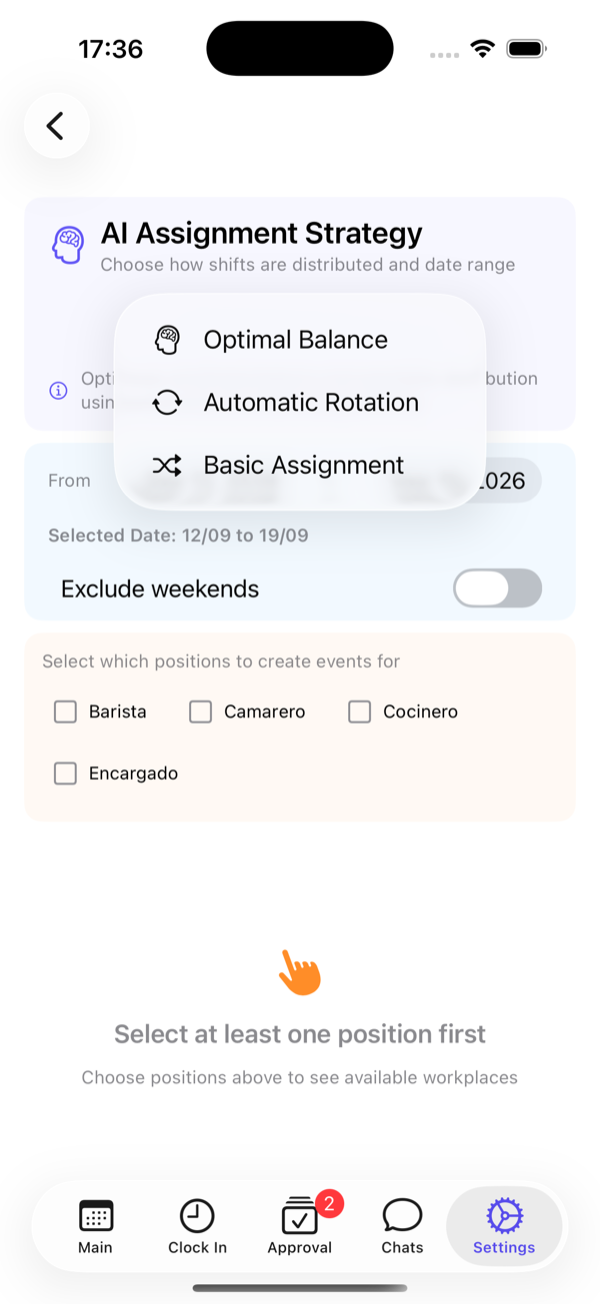
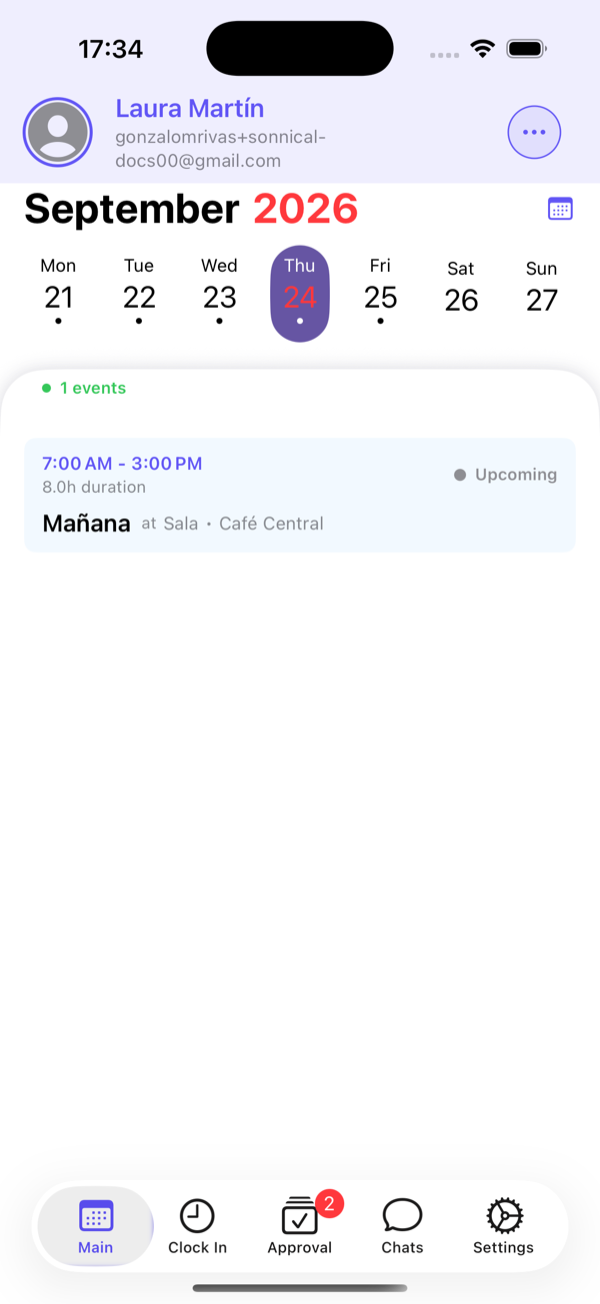
In Sonnical you don’t have to pick the model by hand. You define your business’s shifts (two, three or however many, with their hours), how many slots each one has and which days you open, and you generate as many weeks as you like. When assigning, the Rotational mode does exactly what models 4 and 5 do. Each person keeps the same shift type during the week and moves on the next week (morning → evening → night); the people left over act as floaters filling the gaps. If someone misses a week, they rejoin at the point in the rotation that is theirs, not at the start.
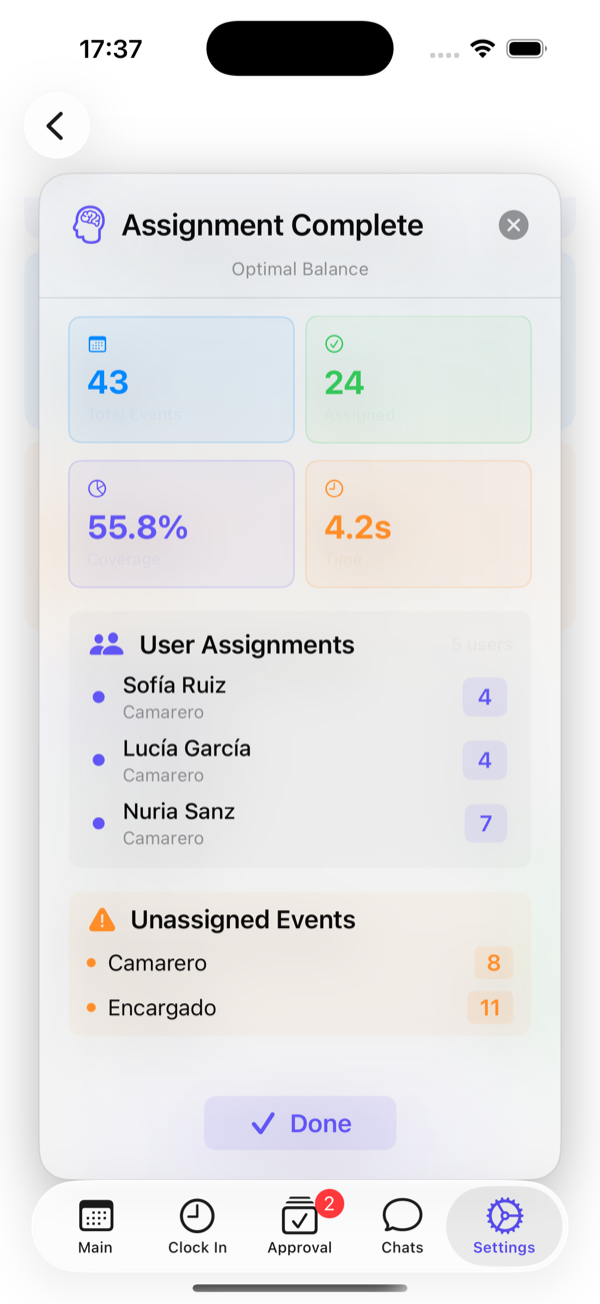
It also checks the same things we have checked by hand in this article: that nobody goes over their contracted hours, that nobody closes and opens, and that the slots are covered. It is free for up to six employees, which is exactly the size of the teams in this article.
Frequently asked questions
Can four people cover morning, evening and night seven days a week?
Not with eight-hour shifts: that is 168 hours a week and four full-timers add up to 160. Either you close one day (model 4), switch to twelve-hour shifts (model 3), or bring in a fifth person, even part-time (model 5).
How many hours does each person get on a four-person rota?
It depends on the slots. With two shifts and one person per shift, 14 shifts between four people is 28 hours on average; with three shifts over six days, 18 shifts come to 36 on average. If contracts are 40 hours and the schedule gives 28, you either have too many people or too little work: that is the cue to add weekend reinforcements rather than invent shifts.
How do I make weekends off fair?
Rotate whole blocks, not single days. In models 1 and 2 the pairs swap the long and the short block every week; in model 5 the floater changes every week. Keep the last four weeks of rotation written on the schedule itself, so anyone can check it.
What happens if one of the four is off sick?
With four there is no slack: someone covers with overtime, or you keep one or two casual staff available for those days. The only way a sick day doesn’t become a crisis is to have planned for it beforehand, with a list of available people and their numbers to hand, or with freelancers who mark their availability in the app.