
Rotating shifts of morning, afternoon and night: how to plan them without burning out the team
On the forums where people talk about their jobs, the words that go with “rotating shifts” are always the same: I can’t get used to it, I have no life, I don’t sleep. And yet some businesses cannot run any other way. The difference between a rotation people can live with and one that drives people away comes down to four decisions almost nobody makes on purpose.
A thread with nearly a hundred comments on a Spanish-language jobs forum was titled “The big problem with rotating shifts: how do you survive this?”. Another, with over eighty upvotes, asked flatly why they exist at all. The answers were not about pay. They were about sleep, about not knowing which days you are off next week, and about a colleague who had been “temporarily” on nights for two months. A hotel manager with thirty years on reception summed it up on LinkedIn recently: changing hours, days off that are never consecutive, constant rotation and nights that wreck your rest. And then: are we really surprised by staff turnover?
This article is for anyone who has to cover morning, afternoon and night and cannot choose not to. It covers the four decisions that make the difference (the direction of the rotation, its speed, how many nights in a row, and what happens when someone is off), the rest rules you cannot skip, and a five-week cycle, table included, that meets all of that with five people.
Decision 1: the direction of the rotation (forward, always)
There are two ways to rotate between morning, afternoon and night. A “forward” rotation follows the clock: morning, then afternoon, then night. A “backward” rotation goes the other way: night, then afternoon, then morning. It looks like a detail and it isn’t. When you move from afternoons to nights, your body has to go to bed later, which is the easy direction. When you move from nights to afternoons or from afternoons to mornings, it has to go to bed earlier, which is far harder. Occupational health guidance has said the same thing for years: forward rotation means less fatigue and fewer mistakes.
Backward rotation also hides a legal problem: from an afternoon to a morning there are usually fewer than eleven or twelve hours between the end of one shift and the start of the next. Closing at 11 pm and opening at 7 am is eight hours. That breaks the daily rest rule in the EU, the UK and most other places.
Decision 2: the speed (weekly, not daily)
Some rotas change the shift every day: Monday morning, Tuesday afternoon, Wednesday night. It is the worst possible option. The body never adapts to anything, and the person lives in permanent jet lag. At the other extreme, rotating every month or every quarter gives time to adapt but leaves someone on nights for weeks, and that is where sick days and “why is it always me” begin.
The middle ground that works in practice is weekly rotation: a week of mornings, a week of afternoons, a week of nights. Everyone knows weeks in advance which shift they will be on, can organise their life around it, and nobody carries more nights than anyone else. If the team is large and nights are especially hard, blocks of two or three days can work, but never one.
Decision 3: how many nights in a row (four at most)
What wears people down is not the night itself but the accumulation. Three or four nights in a row, followed by two days off, is the limit most occupational health guides recommend. Five is already too many, and seven is what shows up in rotas built “so that it adds up”. If your rotation gives someone five or more consecutive nights, the person is not weak: the rota is badly shared.
And after the last night, the first day off doesn’t fully count. Whoever finishes at 7 am spends that day asleep. That is why good rotas give two days off after a block of nights, not one.
The rest rules your rota has to respect
The numbers vary by country, but the logic is the same everywhere: a minimum between shifts, a minimum per week and a maximum number of hours.
| Jurisdiction | Between shifts | Weekly rest | Maximum hours |
|---|---|---|---|
| EU (Working Time Directive) | 11 consecutive hours | 24 uninterrupted hours per week (plus the daily 11) | 48 h average including overtime; lower ordinary limits by country |
| United Kingdom | 11 hours | 24 hours per week or 48 per fortnight | 48 h average (opt-out possible) |
| Spain | 12 hours | A day and a half, can be averaged over 14 days | 40 h annual average, 9 h/day unless agreed otherwise |
| United States (federal) | No federal minimum | No federal minimum | No cap; overtime pay after 40 h (state rules vary) |
| Mexico / Chile / Colombia | No fixed minimum; night shifts shortened by law in Mexico | One day per week (Chile: two Sundays a month on shift systems) | 48 h (MX, falling to 40 by 2030); 42 h (CL, CO) |
Two quick checks before publishing any rotation: nobody has an afternoon followed by a morning the next day, and after a night only another night or a day off comes next. Those two rules remove almost every daily-rest breach. Check your collective agreement or contract for the rest; many set stricter limits than the law.
A five-week cycle that meets all of it (five people, one slot per shift)
The base case: a business that needs one person on mornings, one on afternoons and one on nights, seven days a week. That is 21 shifts a week. With five people there are five roles each week, and each person moves through all five in the same order:
- Mornings: five mornings in a row, Wednesday to Sunday (40 h).
- Afternoons: four afternoons, Monday to Thursday (32 h).
- Floater: two mornings and two afternoons, filling the gaps the others leave (32 h).
- Three nights plus an afternoon: nights Monday to Wednesday and the Sunday afternoon (32 h).
- Four nights: Thursday to Sunday (32 h).
This is the first week. M is morning, A afternoon, N night and O off:
| Person | Role | Mon | Tue | Wed | Thu | Fri | Sat | Sun | Hours |
|---|---|---|---|---|---|---|---|---|---|
| Anna | Mornings | O | O | M | M | M | M | M | 40 |
| Bea | Afternoons | A | A | A | A | O | O | O | 32 |
| Carla | Floater | M | M | O | O | A | A | O | 32 |
| Dan | 3 nights + afternoon | N | N | N | O | O | O | A | 32 |
| Eli | 4 nights | O | O | O | N | N | N | N | 32 |
The following week each person moves to the next role on the list: whoever did mornings does afternoons, whoever did afternoons becomes the floater, and so on. The order is not random: it is the only one of the possible orders in which nobody finishes Sunday on an afternoon and starts Monday on a morning, or comes off four nights straight into a morning. This is what each person does across the full cycle:
| Week | Anna | Bea | Carla | Dan | Eli |
|---|---|---|---|---|---|
| 1 | Mornings | Afternoons | Floater | 3 nights + afternoon | 4 nights |
| 2 | Afternoons | Floater | 3 nights + afternoon | 4 nights | Mornings |
| 3 | Floater | 3 nights + afternoon | 4 nights | Mornings | Afternoons |
| 4 | 3 nights + afternoon | 4 nights | Mornings | Afternoons | Floater |
| 5 | 4 nights | Mornings | Afternoons | Floater | 3 nights + afternoon |
Over five weeks each person has worked 168 hours, 33.6 on average, has spent two weeks with nights and three without, and has never done more than four in a row. Between the block of three nights and the block of four there are three days off and one afternoon. It fits 32- to 36-hour contracts; on 40-hour contracts a few hours are left over each week, which cover sick days and busy periods without overtime.
If your business has two slots per shift instead of one, the cycle is the same with ten people instead of five; if the business closes one day, one role drops out. The point is not to copy this table but to make sure yours meets the same three things: forward direction, weekly change, four nights at most.
Decision 4: what happens when someone is off
This is where most rotations break. Someone falls ill in their week of nights, somebody else covers “just this once”, and by the following week nobody knows where anyone is in the cycle. A month later one person has done three weeks of nights and another has done none.
The rule that prevents it is easy to state and hard to keep by hand: the rotation does not stop for an absence. Whoever is off loses their role for that week, the floater covers them (that is what the floater is for), and when they come back they take the role that is theirs that week, not the one they left. If the floater is the one who is off, each shift’s regular covers their own gap. And everything gets written down, because a rotation that only exists in the manager’s head stops being fair the moment the manager goes on holiday.
How Sonnical does it
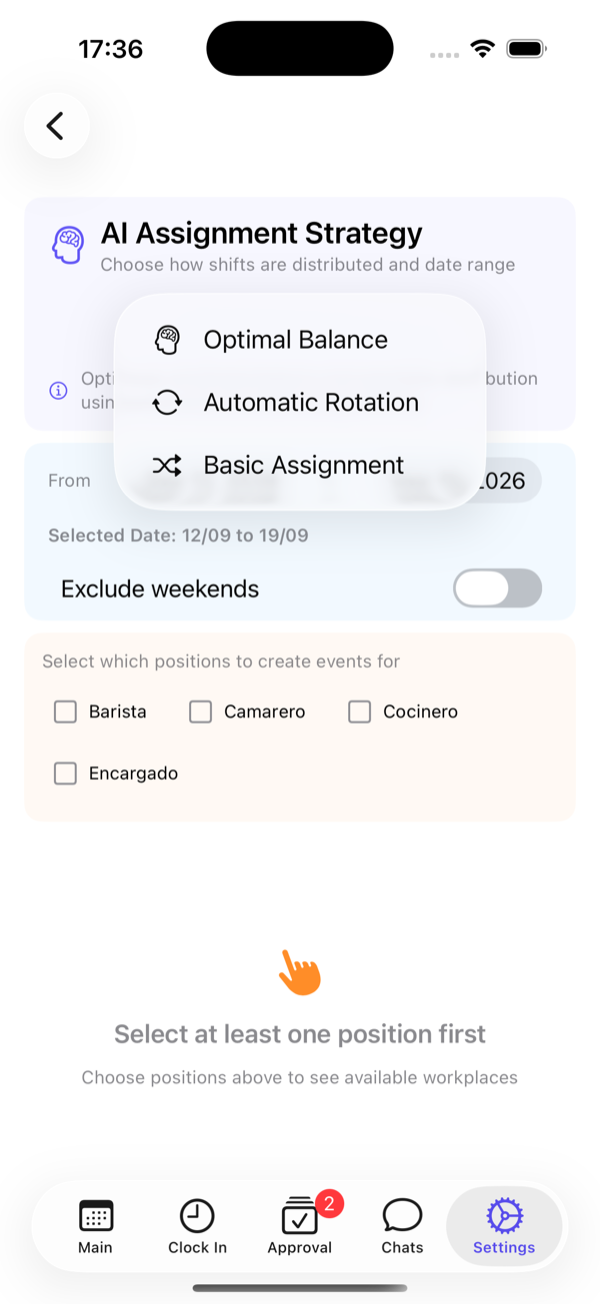
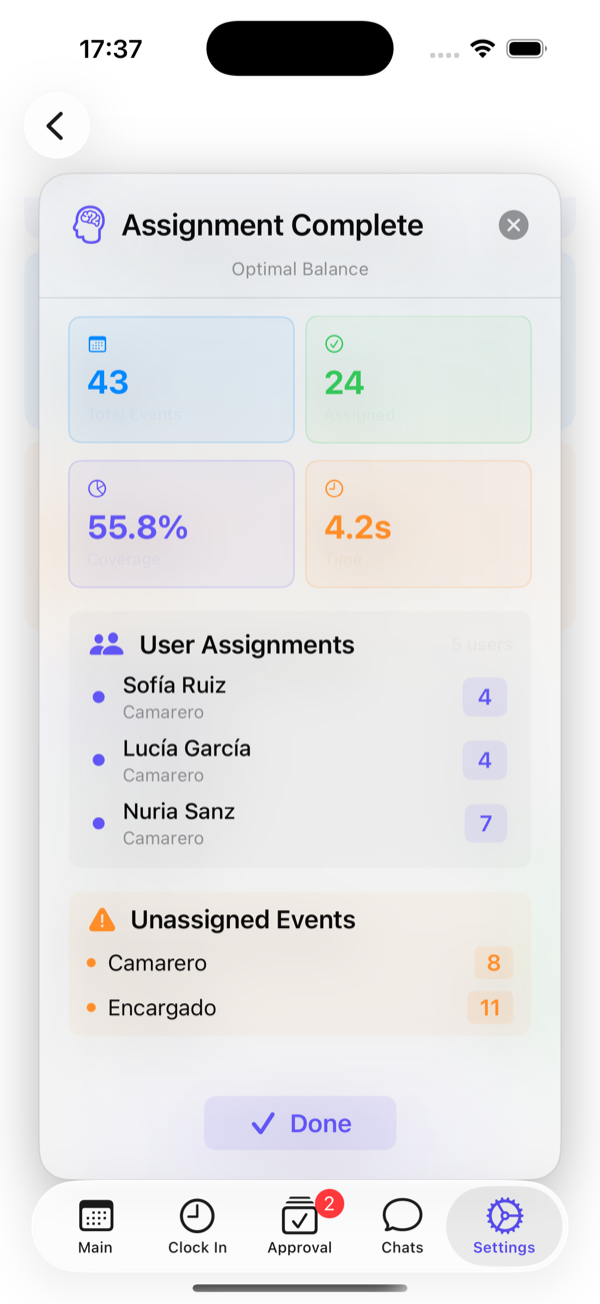
Sonnical’s Rotational mode does exactly what this article describes, week by week. You define your shifts with their hours, how many slots each one has and who is on the team. When assigning, each person keeps the same shift type during the week, moves on the next week in the order morning → afternoon → night, the people left over act as floaters and, if someone is off, the rotation carries on: when they return they take the role that is theirs. Before publishing, the rota is validated: nobody over their hours, nobody with an afternoon followed by a morning, nobody with a night followed by anything other than a night or a day off.
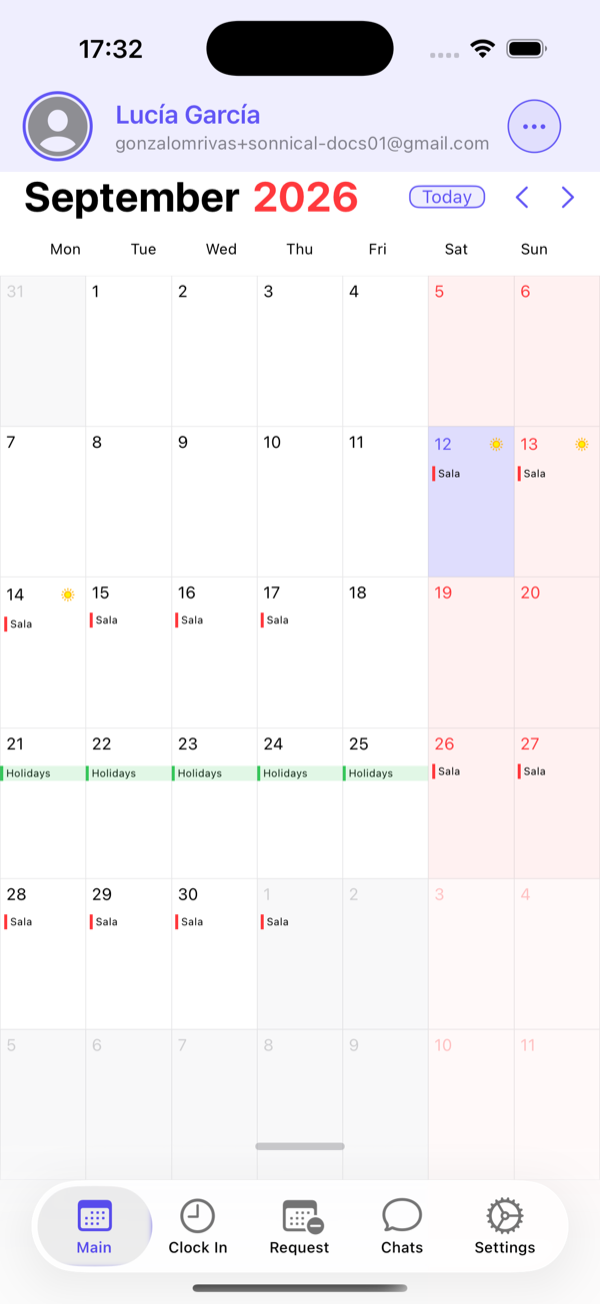
Every employee sees their calendar on their phone weeks ahead, which is the thing shift workers ask for most. And if two people want to swap a week, they request it from the app, and you approve it with the rest checks already done.
Frequently asked questions
Is it better to rotate forward or backward?
Forward: morning, afternoon, night. It is easier for the body to go to bed later than earlier. Backward rotation also tends to leave fewer than eleven or twelve hours between an afternoon and the next morning, which breaks the daily rest rule in the EU, the UK and many other places.
How many nights in a row can someone work?
Most laws set no maximum (some countries shorten the night shift instead), but occupational health guidance recommends no more than three or four in a row, followed by two days off. If your rota gives five or more, it is badly shared.
How often should shifts rotate?
Weekly. Rotating daily never lets the body adapt, and rotating monthly leaves someone on nights for too long. With weekly blocks, everyone knows their shift weeks in advance.
What do I do with the rotation when someone goes off sick?
Don’t stop it. The floater covers whoever is off and, when they come back, they take the role that is theirs that week, not the one they left. If you pause the rotation to wait for someone, within a month you will have one person stuck on nights and another who has done none.